From Unlawful Detention to Justice: A Story of Individual and Institutional Change
Semera Gishan is a Bajaj driver from Boku Shanan, Adama, whose daily income supports his livelihood and family.
One day, after transporting three passengers from Bollo to Tikur Abay, a disagreement arose when the passengers refused to pay the agreed transport fare. The police subsequently brought all those involved to Migira Police Station for further inquiry.
While the other individuals were released, Semera remained in custody for three days without interrogation or being brought before a court within the legally prescribed 48-hour period. Without access to legal assistance, he was unable to understand or challenge the legality of his detention. Semera’s experience was not an isolated case. At Migira Police Station, individuals were sometimes detained for extended periods without timely legal review, contributing to unnecessary detention, pressure on police facilities, and limited protection of suspects’ procedural rights. It was during one of Advocates Ethiopia’s routine pre-trial legal aid outreach visits to police stations in Adama that Semera’s case came to the attention of the legal aid team.
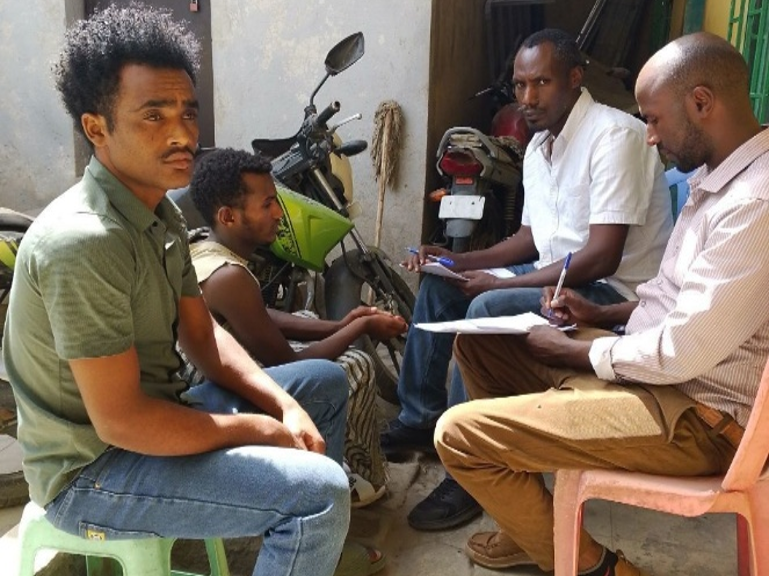
Legal aid providers consulting Semera Gishan inside Migira Police Station
The team assessed the circumstances surrounding his detention and engaged directly with police officers, including Inspector Bikiltu and other relevant officials at Migira Police Station. They explained the applicable legal procedures, highlighted Semera’s right to due process, and raised concerns that there was insufficient legal justification for his continued detention. Through constructive dialogue and legal engagement, the team supported the review of Semera’s case. The police subsequently agreed to release him, allowing him to return to his work as a Bajaj driver the following day. For Semera, the intervention meant regaining his freedom and being able to resume the livelihood on which his family depends.
But the change did not stop with one case. Continued engagement between legal aid providers and police authorities contributed to improvements in detention management at Migira Police Station. Regular legal aid presence, awareness-raising and dialogue strengthened understanding of due process requirements and the importance of timely case review.
Police officers increasingly focused on reviewing cases promptly, avoiding detention without sufficient legal grounds, and ensuring that suspects are brought before courts within the required timeframe. The number of detainees held at the station also declined significantly, from previously more than 30 at a time to generally fewer than five.
Reflecting on his experience, Semera said:
“If Advocates Ethiopia had not intervened, I believe I would have remained in detention much longer or been forced to pay money just to regain my freedom. Their support gave me justice when I had no one else to help me.”
For Semera, legal aid provided a pathway out of a situation he could not challenge on his own. For the police station, continued engagement with legal aid providers has helped strengthen attention to lawful detention and due process.
The change demonstrates how accessible pre-trial legal aid can address an individual case while also contributing to improvements in institutional practice. Advocates Ethiopia’s case records and feedback from police officials provide evidence of the intervention and the reported changes in case review and detention management.
Advocates Ethiopia and its consortium partners will continue providing pre-trial legal aid through regular visits to police stations, alongside one-to-one legal counselling and group legal awareness. Continued engagement with law enforcement will support efforts to strengthen lawful detention practices and ensure that vulnerable individuals are better able to understand and exercise their rights.