Pre-court legal aid now available in Ethiopia from Lawyers for Human Rights
Lawyers for Human Rights (LHR) is improving access to justice and strengthening human rights protections within Ethiopia’s legal system through offering free pre‑trial legal aid services.
LHR is the leading civil society consortium in Ethiopia, it includes Mizan Lawyers Centre (MLC) and Advocates Ethiopia (AE). Their work is funded by the Civil Society Innovation Fund (CSIF).
The consortium bridges the gap between detainees and the justice system, ensuring that vulnerable individuals are not left without support. Through creating conversation between police institutions, justice bureaus, and other justice sector actors in Ethiopia they team are already improving access to justice and addressing systemic challenges, such as language barriers.
What is the service?
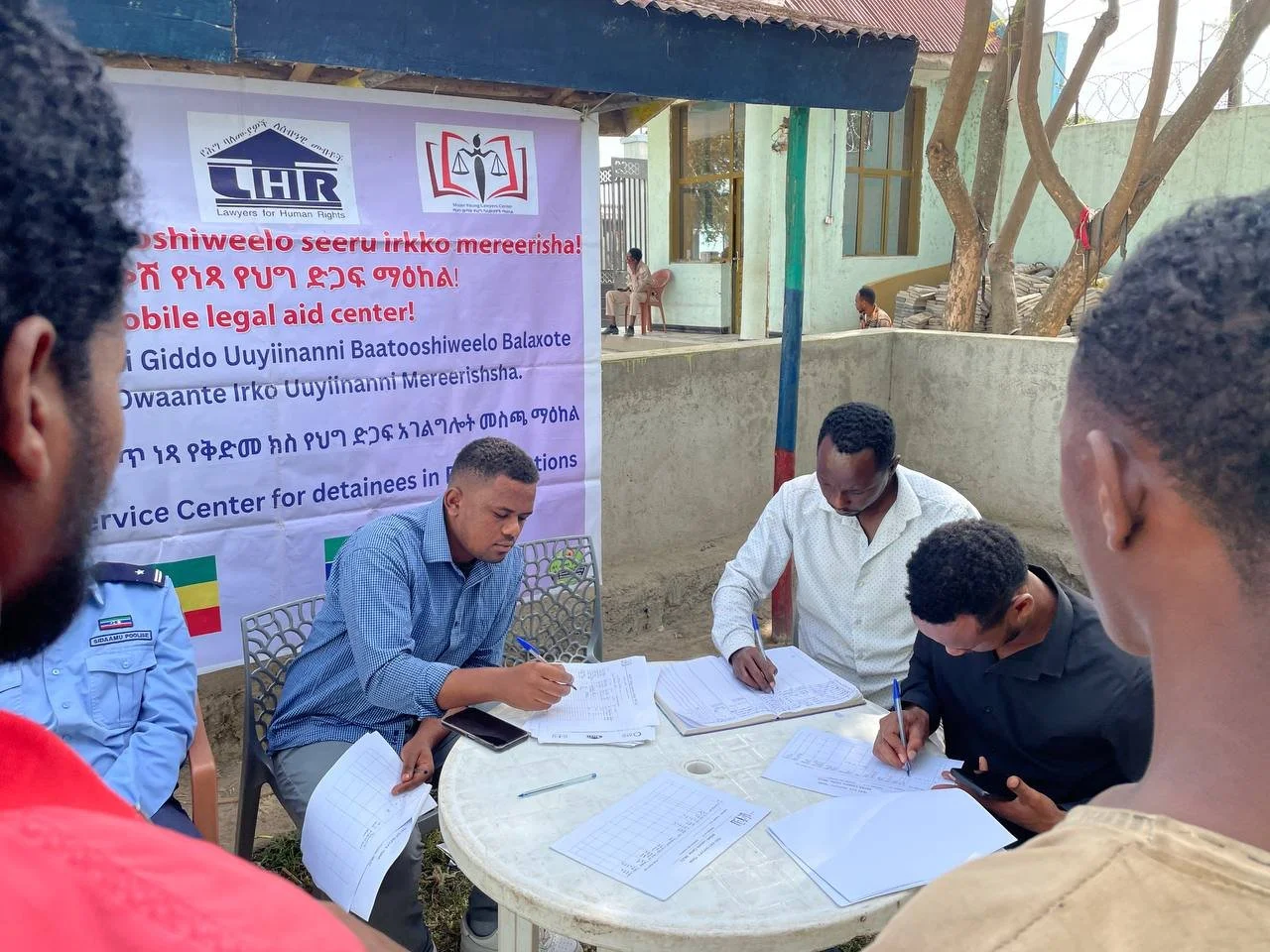
LHR has established 8 legal aid centers and 1 Legal Aid Coordination Center across Addis Ababa, Adama, Hawassa, and Wolayta Sodo, in Ethiopia. The legal aid centers are strategically located within police stations in Hawassa and Wolayta Sodo and in close proximity to police stations in Adama and Addis Ababa. This placement enables legal aid providers to reach detainees at the earliest stage of detention.
LHR offers legal advice and consultation, bail application support, case assessment and follow-up, rights awareness and legal education, referral and coordination with justice institutions, and legal guidance. They also work closely with police officers to build awareness of detainees’ rights and improve rights-based pre-trial procedures.
Working with detainees’ family members is also central to the service. In many cases, legal aid providers cannot immediately access detainees inside detention facilities, and family members play an important role in facilitating legal support.
Beyond this LHR looks to improve the pre-trial justice environment more broadly.
Capacity-building training is provided to police officers to strengthen awareness of detainees’ rights and human rights standards during arrest, detention, and investigation
Bring together key actors in the justice system through events and activities to discuss challenges, share learnings and strengthen commitment to pre-trial legal aid services.
These interventions help improve collaboration, contributing to stronger institutional accountability and better protection of detainees’ rights.
How many people has the service supported?
Before LHR’s legal aid service was established there was no one providing free legal support for pre-trial detainees.
From October 2025 to March 2026, 3,178 detainees have received free pre‑trial legal aid service, including 342 women. As a result of these interventions, 131 detainees were released from prison, underscoring the consortium’s vital role in safeguarding rights and ensuring access to justice at the earliest stage of detention.
One detainee supported by the consortium was Mr. Tadele Eshetu, a seventy-year-old security guard who was arrested on suspicion of attempted murder after firing a single warning shot into the air to de-escalate an attack and prevent the seizure of his service firearm. Despite the absence of injury, intent, or a complainant, he was detained. The consortium legal aid providers assessed the case and submitted legal arguments on proportional defensive action and lack of criminal intent. After sustaining legal proceedings, Mr. Tadele was fully acquitted and released. Reflecting on the support, he stated:
“At my age, I thought prison was the end of my life. The lawyers stood for me when I had no strength left. They returned my hope.”
Another important case comes from Wondo Genet, where four individuals detained under suspicion of homosexuality faced prolonged custody without evidence or legal counsel. The consortium’s Mobile Free Legal Aid Team intervened by advising the detainees on their rights and guiding police and prosecutors to apply Article 41 of the Ethiopian Criminal Procedure Code, which requires dismissal of cases lacking evidence. LHR facilitated the closure of the case and secured the detainees’ release. These cases demonstrate how timely legal intervention protects liberty, prevents prolonged detention, and restores dignity.
Why is this needed?
The justice sector in Ethiopia continues to evolve, but major challenges remain, particularly during arrest, detention, and investigation.
Although Ethiopian laws recognize the rights of detainees, access to legal support at the early stage of criminal proceedings remains limited. Many detainees do not understand the charges against them, their rights during detention, or how to prepare a defense. As a result, they face a greater risk of prolonged detention or wrongful conviction. This challenge is especially true for vulnerable groups, including women, persons with disabilities, and low-income detainees.
Many detainees are also illiterate or come from regions where they do not speak the local language. They may struggle to understand legal documents presented to them and may unknowingly sign statements without understanding their legal implications.
In this context, pre‑trial legal aid is indispensable. It ensures that detainees are informed of their rights, treated fairly, and able to access justice from the earliest stage of proceedings. By addressing systemic gaps and protecting vulnerable populations, pre‑trial legal aid strengthens the integrity of Ethiopia’s justice system and upholds fundamental human rights.
Watch this documentary, it highlights the consortium’s work and the impact of pre-trial legal aid services. It has supported conversation within the justice sector and contributed to procedural improvements, including efforts to reduce overcrowding in police detention facilities and strengthen fairer pre-trial justice practices in Ethiopia.