Supporting women fleeing violence in Ethiopia
Globally, almost one in three women have experienced physical and/or sexual violence at least once in their life. This violence is often perpetrated by current or former intimate partners. In humanitarian contexts gender-based violence (GBV) affects a shocking 70% of women.
Ethiopia has experienced cycles of civil conflict for many years, and some areas of the country still see some levels of violence between communities. As a result, gender-based violence (GBV) has become an everyday reality for many women, with little support historically available to them. One of our Civil Society Innovation Fund (CSIF) consortium groups, the Sewmehon Alliance, meaning "Being Humankind", is working to change that.
They support GBV survivors through five safehouses established across Ethiopia, each supporting roughly 180 women a year. These safehouses provide medical aid, mental health support, court assistance, self-defense training, and financial guidance. Women arrive through police station referrals, family intervention, or referrals from religious organisations, and they can stay for up to two months. Once they leave, social workers continue supporting them in their own homes.
Hear the story of Kebedu to understand how Sewmehon Alliance support womens’ to build better futures.
Before the CSIF Ethiopia-supported intervention, Kebedu’s daily life was defined by uncertainty, and a need to survive. A mother of three, she is a survivor of GBV. And due to the violence, she experienced, for over two years she couldn’t maintain a steady job. The violence she endured stripped her not only of physical safety but also of confidence. At this time, Kebedu and her children slept in a fragile plastic-built shelter, offering little protection. Meals were unpredictable; some days they depended entirely on begging from neighbors or passersby. Her children, themselves survivors of violence, were out of school and spent their days in an unsafe environment, mirroring their mother’s fear and uncertainty.
Kebedu had no secure income, no savings, and no access to healthcare. Even basic decisions, such as where to sleep or how to feed her children the next day, were shaped by crisis rather than choice.
Thanks to the support of the CSIF Ethiopia programme, the project consortium was able to support Kebedu. She received immediate support, and her family moved into a rented home. Food support, medical care, and counselling services helped her rebuild herself both physically and emotionally.
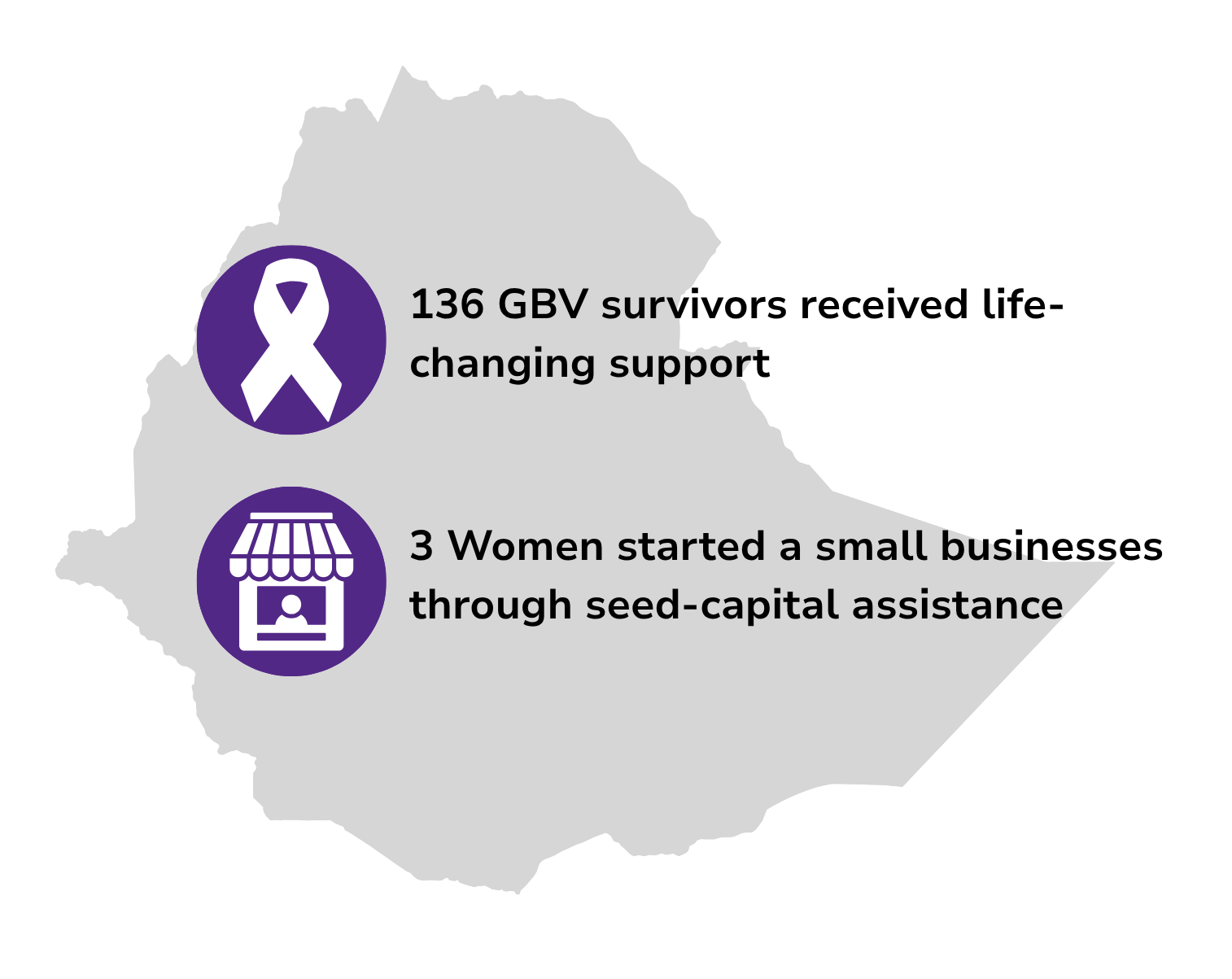
The support for GBV survivors under the CSIF Ethiopia Programme from Aug 2025 to Jan 2026
Eventually, Kebedu found work through a local recruitment agency, taking on small domestic job such as washing clothes and cooking, while her children were supported to return to school. She was later selected for individualized income-generating activity (IGA) support.
With seed capital and skills building support, Kebedu started a small business selling clothes and shoes, finding her independence. She is now able to pay for house rent, provides regular meals, and covers school expenses for her childrens’.
Kebedu’s transition from homelessness to self-employment demonstrates how economic stability can restore dignity, safety, and hope. This support reduced her vulnerability to further violence and allowed her as a mother to care for her family as their decision maker.
How else does Sewmehon Alliance support positive change to reduce GBV?
In addition, Sewmehon Alliance is working to develop advocacy skills with small grassroots organisations working on gender equality, human rights and peacebuilding by strengthening the civil society in Ethiopia.
The consortium is also working to shift how society views women's roles, sharing women's stories from targeted areas that highlight them as everyday heroes in their communities.
They are also creating a comic book that addresses a wide range of issues, including the role of women in the family, the economic challenges facing female university students that leave them vulnerable to exploitation, the abduction of girls in rural areas, and the migration of girls to Addis Ababa in search of work to support their families.
The comic also tackles the practice of dowry, and how rape is sometimes used to devalue a woman so that her rapist can marry her without paying a dowry to her family. In these cases, a woman who has been raped is often seen as "damaged" and impure, which the perpetrator exploits to avoid the cost of marriage. By raising awareness of these issues, the comic challenges harmful social norms around gender roles.
The overall aim is that through education on gender roles, alongside direct support for those facing GBV, people's attitudes will begin to shift towards seeing women and men as equals — helping to reduce violence and expand women's rights and opportunities.
The cover image is generated by AI